

Vladimir Tarasov. 1960th. 2009. Multimedia installation. Courtesy of artist and Multimedia Art Museum, Moscow
Special projects in frame of 3rd Moscow Biennale of Contemporary Art
Vladimir Tarasov “Chushala”
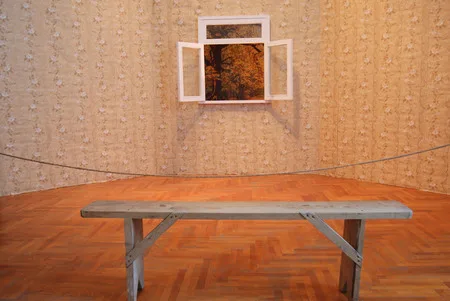
My father was born in Chushala, a coastal village once inhabited by Vikings beside the River Pinega, a tributary of the Northern Dvina. The Pinega flows into the Northern Dvina in 300—400 kilometres from Archangelsk. I remember walking through the village with my brother when we were little. In the evenings our parents wouldn’t let us out after dark. We sat on a bench at a large table with a samovar. The windows were open. I looked at the golden autumn forest. Old women of seventy, eighty and ninety sat outside singing Russian folk songs.‘Chushala’ is dedicated to my parents. To my father and to the place.
Vladimir Tarasov
Vladimir Tarasov “Gobustan”
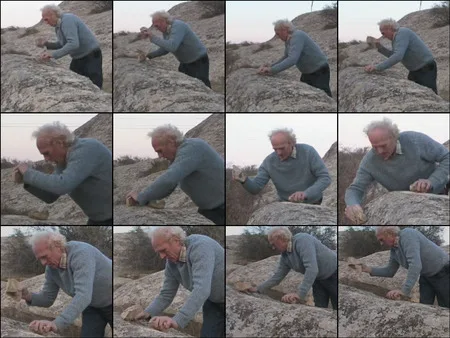
For several hours we had been driving a small jeep around the tracks of ancient Gobustan, near Baku. This was my second expedition in these parts, and I still cherished the hope of seeing the first stone drum in human history. Once again I was disappointed and doubtful that we would ever discover anything more than a small resonant stone in the area belonging to the museum, but Ali, a Baku artist, assured Vitaly Patsyukov and I that he remembered the location and we would definitely find it. It was almost evening before a huge boulder balanced on two other stones came into view on the mountainside and we realised this was the Great Ritual Instrument. Clearly this was the way it had to be. The stone with its penetrating sound that carried across the entire territory of this ancient human encampment was only revealed to us after an arduous search.Vladimir Tarasov
Vladimir Tarasov “1960s”
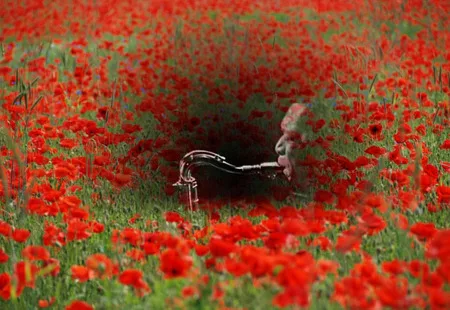
This installation is dedicated to the 1960s, when another wave of creative energy gave every musician and artist the opportunity to create their own unique style. Many artists were involved in the use of stimulants, but in those years dope was also an intoxicating feeling of something hanging in the air, when the musician — and through him the spectator too — became part of this remarkable energy.Vladimir Tarasov
Vladimir Tarasov “IN BETWEEN”
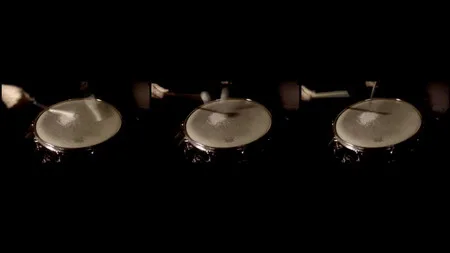
Instead of us looking at the old paddle-wheel steamer ‘sloshing’ up the Northern Dvina the steamship scrutinizes us, lost in its own thoughts and measuring the river water that churns around it. That is probably how I perceived the sound of the place. The steamship ‘Gogol’ is the last remaining Russian paddle-wheel steamer, happy that it still has the chance to convey tourists along the Northern Dvina once in a while. To me the compelling, endless rhythmic motion of the wheel and the splash of water sounded like a small drum played with brushes. And the inner state and emotions are like hearing the outstanding American musician Mark Dresser on double bass.Vladimir Tarasov
Vladimir Tarasov “SOUND GAMES”
Vladimir Tarasov’s ‘SOUND GAMES’ exhibit is a series of sound installations presented by MAMM at the Manezh central exhibition hall as part of the Third Moscow Biennale of Contemporary Art.
Vladimir Tarasov is a celebrated musician and artist, co-author of many sound installations with Ilya Kabakov, including a project awarded the Golden Lion at the Venice Biennale in 1993. The ‘SOUND GAMES’ series of installations are universal plastic, rhythmic and sound schemas that refer contemporary culture to its roots. The dramaturgy of this project is the history of civilisation from the very earliest auditory and visual structures to the present day.
The ‘GOBUSTAN’ installation articulates the epic world of primordial sounds. ‘CHUSHALA’ is related to childhood and folk culture. ‘IN BETWEEN’ sees these archetypes beginning to interact with the socio-technological artefact. And in the installation ‘The 1960s’ the artist plunges the spectator in the fluctuating stratification of sensory space, forming a universal metaphor of the mid-20th century and its legendary heroes: Miles Davis, Glenn Gould, John Coltrane, Ravi Shankar and Jimi Hendrix.
Olga Sviblova
“…sound is transformed into shape…”
…where sound is transformed into shape
J. L. Borges
Vladimir Tarasov’s ‘Sound Games’ are filled with universal meanings and images. It contains within itself a specific
Steeped in the archaic settlements of Absheron, the installation ‘Gobustan’ opens up a majestic world of primordial sounds — man’s first rhythmic contact with the reality of planet Earth. Anton Webern,
Through glancing into the past and experiencing its reconstruction in tangible personal impressions, Vladimir Tarasov returns to contemporary culture its canonical figurativeness, fundamental archetypes in which coded reality is revealed. This future always begins with an immersion in personal memory. The artist testifies to the force of our desire to reach that place where we can concentrate on the ideal, its centring in the phenomenon of childhood and the light forms that trigger human memory. Their locality, mystery and charm lie concealed in the northern coastland, in that sublime childhood feeling of connection with nature and its sounds — nocturnal stirrings in the forest, birdsong and grandma’s voice ‘telling’ ancient history — the old Russian song, northern folklore genuine in its candour. The sound of the samovar, a true sense of calm, the measured tones of the human voice and the protective gesture of the surrounding world created a unique environment for the birth of those invigorating, rhythmically repetitive processes of the soul that were later reflected in the celebrated ‘Chushala’ installation. The visual and acoustic spaces of ‘Chushala’ are entirely iconological and alive within them we perceive the traditions of transition from an archaic world to the radical ‘garden of magnitude’ of the present day. Fluctuating in the organics of the installation are those decisive impulses that throughout our history and unbeknown to us have led to what we now are, preserving our
Their plastic meanings can discover this equilibrium in the fluxus strategy, as they do in the installation ‘In Between’ — in a dialogue with a technological artifact (a steamboat engine), rhyming its rhythmic contours with the handmade sound of the wonderful American bassist Mark Dresser.
The magic of the space that appears through the revolving wheel of the steamship, this nostalgic image of a vanishing civilisation, an image connected to the natural quality of water and augmented by the propulsive sound of Mark Dresser's double bass. All this produces a special dramaturgy of unique harmony, a taut yet absolutely transparent
‘Sound Games’ contains a paradoxical cyclicity within itself, demanding constant return to the Dionysian conditions of culture, to the piercing immediacy of the utterance, rhythmically altering the motifs of ebb and flow, forming the ‘breath’ of art. Its final phase, ‘The Sixties’, in presenting itself as a poppy field, a depth of reddening plasmic states, immerses the viewer into a flickering foliation of a sensory space, into unique meditative energy, where legendary figures of the
Vitaly Patsukov
Where it was shown
Central exhibition hall ManegeMoscowМанежная площадь, д. 1
22 September — 25 October 2009
Supported by