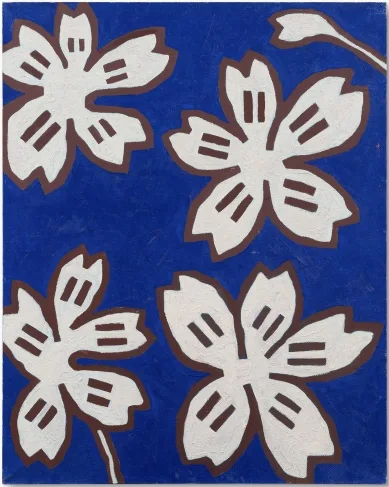
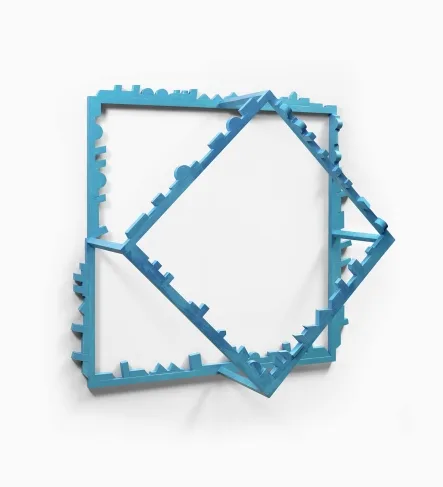
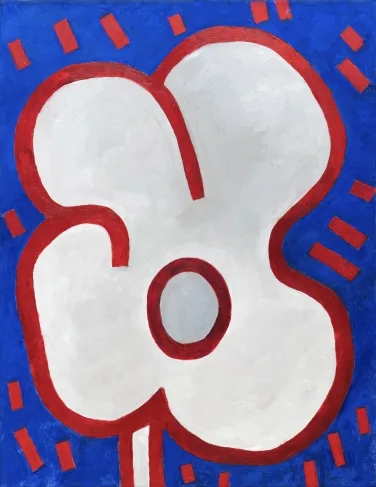
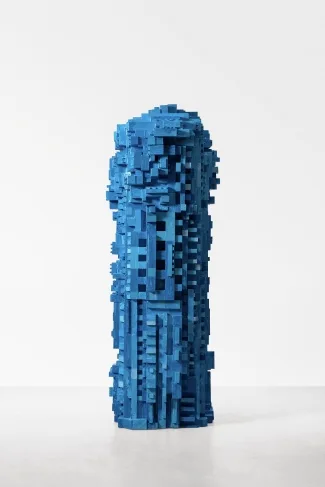
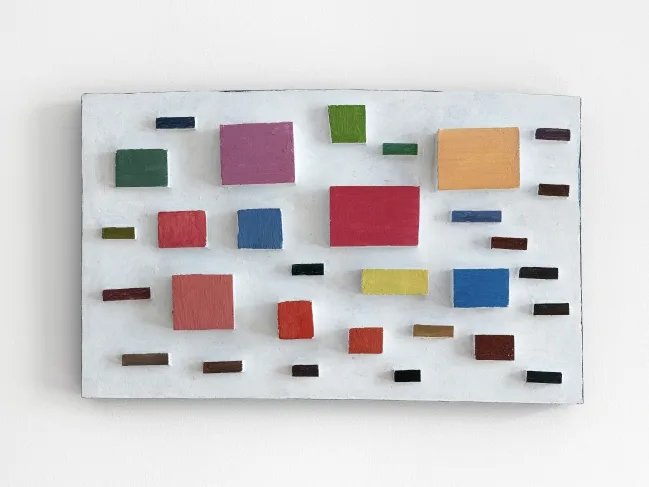
Игорь Шелковский. Из серии «Цветы». 2006 Холст, масло. Предоставлено Alina Pinsky Gallery.
About the exhibition
Igor Chelkovski
Sky City. Artist’s Studio
Curators: Anna Zaitseva, Maria Lavrova
Co-organisers: Alina Pinsky Gallery
The Multimedia Art Museum, Moscow presents ‘Sky City. Artist’s Studio’, an exhibition by Igor Chelkovski.
Igor Chelkovski is an outstanding contemporary artist and sculptor, a classic of Russian and world art. From 1979 to 1986 he was the publisher and editor of the legendary magazine A-Ya.
This large-scale retrospective exhibition at MAMM covers almost 70 years of Chelkovski’s work, from the 1960s and 1970s to the present. More than 600 sculptures, paintings and graphic works by the artist are featured.
Igor Chelkovski was born in 1937. In 1954 he began studying in the Theatre and Scenery Department of the Moscow Art School in Memory of 1905. His course was headed by the constructivist Viktor Shestakov, who worked as the chief artist at Vsevolod Meyerhold’s theatre in the 1920s.
Even during his studies Chelkovski became interested in non-objective art, growing close to the circle of artist Vladimir Slepyan, which included key figures of post-war abstractionism such as Yuri Zlotnikov and Boris Turetsky. At the same time Chelkovski met the unique painter Fyodor Semenov-Amursky, who became one of his main teachers.
From 1962 to 1966 Chelkovski worked as an artist-restorer in the Moscow Kremlin and Veliky Novgorod, where he restored the paintings of the St. Sophia Cathedral and the frescoes of Theophanes the Greek at the Church of the Transfiguration of the Saviour on Ilyina Street. This work experience gave the impetus for his own artistic experiments. In particular his work is based on the icon-painting technique of ‘priporokh’. Old Russian masters pierced the contours of the image on paper with a needle, applied the sheet to a gesso (primed) surface, filled the holes with charcoal powder and obtained a dotted drawing for subsequent tracing. Chelkovski’s dotted and perforated images ‘attune’ the viewers’ perception, redirecting them from the position of a passive observer and, according to the artist, “activating the eye, giving it the opportunity to wander in search of the whole and to organise this by itself”.
Igor Chelkovski’s pictorial system can be described as meta-avant-garde. It was formed under the influence of two internally related traditions. His works reflect the motifs of Old Russian art and wooden architecture, with the complex carving of window frames, geometric and foliate decoration, as well as searches for the analytical foundations of form-making, which were the focus of the Russian avant-garde. The artist’s reliefs and sculptures continue the traditions of avant-garde artists Kazimir Malevich, Ivan Puni, Vladimir Tatlin, and Ivan Kliun.
Chelkovski's first acquaintance with the Russian avant-garde took place in the 1960s during his work as a restorer, when he was allowed to visit the storerooms of the Tretyakov Gallery. He was amazed by the works of Marc Chagall, Vasily Kandinsky, and other modernists.
The late 1960s and early 1970s became a turning point in Chelkovski’s biography. On a trip to the House of Creativity for Sculptors in Pereslavl-Zalessky he met Alexander Kosolapov, Leonid Sokov and Boris Orlov; like them, he took up sculpture. In 1971, as a member of the Moscow Union of Artists, Chelkovski was given a separate workshop on Sretenka. It became a centre of attraction for young artists: Dmitry Prigov, Boris Orlov, Rostislav Lebedev and others. Thanks to this studio Chelkovski had the opportunity to work with three-dimensional forms, and from that time on sculpture became his main medium.
However, Chelkovski’s three-dimensional compositions retain a direct connection with his painting. He translates quite traditional pictorial subjects and genres (landscape, portrait, still life) into volume, while rethinking them in accordance with his artistic and philosophical optics. In reliefs from the ‘Summer Days’ series, the classical landscape is transformed into a conventional, generalised model of the landscape, while ‘Clouds’, inspired by the eponymous landscape of Arkhip Kuindzhi, become a three-dimensional and ordered structure.
In 1975 Chelkovski had a fateful meeting with the collector George Costakis, who immediately saw in the artist a continuer of the traditions of the Russian avant-garde and acquired three sculptures for his collection. One of them, now in the collection of the AZ Museum, is shown at the exhibition. Visiting Costakis’ apartment, Chelkovski found himself in a museum of the avant-garde: the walls were covered from floor to ceiling with masterpieces by Kazimir Malevich, Alexander Rodchenko, El Lissitzky, Vladimir Tatlin, Olga Rozanova, and others. The years 1975 to 1976 were a time of close communication with Costakis, which lasted until the collector’s death. His discerning eye, formed by the Russian avant-garde, proved very important for Chelkovski. This period became incredibly fruitful for the artist.
In 1976 Chelkovski found himself in France. The artist’s Moscow workshop was demolished, and in Paris he was offered a studio in the city of Elancourt. In the second half of the 1970s and the 1980s Chelkovski continued to work mainly on sculpture and devoted a lot of time to publishing the magazine A-Ya, thanks to which, during perestroika, the whole world learned about contemporary Russian art on the other side of the Iron Curtain, and nonconformist artists realised themselves as part of a global community.
Chelkovski himself gave the most accurate definition of his sculptures, calling them ‘drawings in the air’. “I am not interested in the mass of stone, plaster or bronze, but rather in the outline, the scheme, the transparency. It’s as if I’m drawing in the air, the eye sees lines, contours, and only the imagination creates the general, that is, the object itself.” The artist emphasises that all of his works, even the most abstract, “have some kind of reality as a point of departure”. Nature, the visible world, is a constant source of his creativity. By reducing the image of a specific object to a geometric figure or line, Chelkovski exposes its internal structure and turns it into an archetypal symbol, the eidos. In the artist’s interpretation trees, flowers, animals, and human figures become plastic formulae, constituent elements of the universe he has created.
It is only natural that the theme of the city is a recurring theme in Chelkovski’s work. The energetic pulsations of urban space are materialised either in rigid lattice silhouettes, similar to drawings or diagrams, or in structures that seem to have grown from fractals. Visually they refer to Malevich’s architectons and planites – models of space structures for people of the future, which Chelkovski first saw at the Paris-Moscow exhibition in 1979. Chelkovski’s extremely ordered, plastically verified cities harmonise both natural and manmade nature.
The most important conceptual part of the exhibition is Igor Chelkovski’s workshop, which the artist agreed to move to the museum halls. The exhibition at MAMM offers the unique opportunity to find yourself in a space usually closed to prying eyes and accessible only to a narrow circle of invited people. Chelkovski’s studio is his magnum opus (Latin for ‘great work’) – a total work of art that is uninterrupted in its development. According to the artist, each new studio determines the beginning of a new stage in his work. There is nothing accidental in Chelkovski’s workshops: everything takes its place according to the internal dramaturgy of the space, and even most of the furnishings were invented and made by the artist. The white colour is also no coincidence, reminiscent of both white-stone churches and Malevich’s cosmos. In this ‘sky city’, a garden city, Chelkovski embodies a model of the universe based on the universal laws of nature and world harmony.
MAMM is grateful to the following for providing works for the exhibition:
State Tretyakov Gallery, and personally the General Director Elena Pronicheva;
Moscow Museum of Modern Art, and personally the Director Vasily Tsereteli;
AZ Museum, Moscow, and personally the Director Natalia Opaleva;
TFS Group;
Vladimir Antonichuk;
Paruyr and Ekaterina Davtyan;
Anton Kozlov;
Iveta and Tamaz Manasherov;
Igor Markin;
Denis Khimilyayne,
and also the collectors who wished to remain anonymous.
The museum expresses special gratitude to the Alina Pinsky Gallery and personally to Alina Pinsky, who has presented and supported Igor Chelkovski’s exhibition projects for the last few years.
Where it was shown
Multimedia Art MuseumMoscowУл. Остоженка, д. 16
8 October 2024 — 16 February 2025

Strategic partner of the museum

Partner of the museum

General radio partner

Strategic media partner

Specialist media partner

Media partners